

Pokémon card rarity symbols are the small marks printed next to the card number at the bottom of the card: a circle means Common, a diamond means Uncommon and a star means Rare. Since Scarlet & Violet (2023), higher rarities use more stars and colors: two black stars for Double Rare, two silver stars for Ultra Rare, one gold star for Illustration Rare, two gold stars for Special Illustration Rare and three gold stars for Hyper Rare.
The symbol tells you how often a card is pulled, not what it is worth. So this guide pairs every symbol with real numbers: the median TCGplayer near-mint market price (USD) of each rarity across 16 Scarlet & Violet sets and 7 Mega Evolution sets, from FoilScan's daily price record as of November 24, 2026 (most cards last updated November 23 or 24). They are reference prices, not appraisals.
Pokémon card rarity symbols chart
This is the system used in every main set since Scarlet & Violet in 2023, and Mega Evolution sets (from September 2025) kept it. Each price is the median market price of every priced card of that rarity: 16 Scarlet & Violet sets, from Scarlet & Violet to White Flare, and 7 Mega Evolution sets, from Mega Evolution to Delta Reign.
| Symbol | Rarity | S&V | Mega |
|---|---|---|---|
| ● Black circle | Common | $0.15 | $0.14 |
| ◆ Black diamond | Uncommon | $0.16 | $0.14 |
| ★ One black star | Rare | $0.20 | $0.18 |
| ★★ Two black stars | Double Rare | $0.71 | $0.61 |
| ★★ Two silver stars | Ultra Rare | $2.05 | $1.80 |
| ★ One gold star | Illustration Rare | $11.42 | $3.18 |
| ★★ Two gold stars | Special Illustration Rare | $23.61 | $34.07 |
| ★★★ Three gold stars | Hyper Rare / Mega Hyper Rare | $7.60 | $144.74 |
What each rarity looks like on the card:
- Common, Uncommon: regular cards, no foil on the art.
- Rare: holofoil art, regular frame.
- Double Rare: a regular ex card with holofoil art.
- Ultra Rare: a full-art ex card or a full-art Trainer.
- Illustration Rare: full-card artwork, usually of a regular Pokémon.
- Special Illustration Rare: full-card story artwork of an ex or a Trainer.
- Hyper Rare: a gold, textured card. In Mega Evolution sets this tier is the Mega Hyper Rare, one or two per set.
Two quick rules from this table. First, everything with a black symbol (circle, diamond, one or two black stars) is a pack card that usually sells for under a dollar: only 26 % of Scarlet & Violet Double Rares reach $1. Second, any gold star is worth a closer look: every Scarlet & Violet Illustration Rare is above $1, and 60 % of the 228 Special Illustration Rares are at $20 or more. The Special Illustration Rare guide prices every SIR set by set.
Mega Evolution Illustration Rares are much cheaper than the Scarlet & Violet ones so far ($3.18 against $11.42), while their Special Illustration Rares are higher ($34.07). Mega Hyper Rares sit far above the old Hyper Rare because each set has only one or two of them.
A reverse holo (foil everywhere except the art) has the same symbol as the normal print of the card, so the symbol will not tell you about the finish. In these sets a reverse holo Common has a median of $0.23, against $0.15 for the normal print. On older cards the gap is far bigger: see holo vs reverse holo for the prices by era.
Where to find the rarity symbol on a Pokémon card
Look at the bottom of the card, next to the card number (for example 161/131).
- Modern cards (Scarlet & Violet and Mega Evolution): bottom left corner, on the small line with the regulation mark letter, the set code and the card number.
- Cards from before 2023: in a bottom corner, right next to the card number.
- The first sets from 1999 and 2000: bottom right, below the artwork box, next to the number. Base Set has no set symbol at all, but it does have a rarity symbol.
The symbol is tiny and the colors (black, silver, gold) are easiest to tell apart under a bright light. If you cannot read it, scan the card: FoilScan finds the exact printing and shows its rarity, finish and market price.
The most valuable card of each rarity
The median tells you what a typical card of a rarity sells for. The top of each rarity shows how far one card can go above it (both eras, November 24, 2026):
| Rarity | Top card | Price |
|---|---|---|
| Common | Slowpoke, Stellar Crown | $2.40 |
| Uncommon | Mist Energy, Temporal Forces | $1.97 |
| Rare | Gengar, 151 | $2.66 |
| Double Rare | Latias ex 076/191 | $11.71 |
| Ultra Rare | Gengar ex 193/162 | $51.60 |
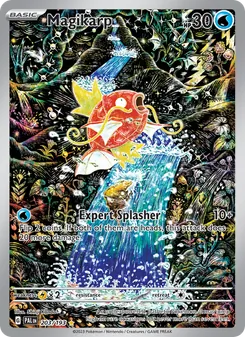
| Illustration Rare | Magikarp 203/193 | $284.08 |
| Special Illustration Rare | Umbreon ex 161/131 | $1,130.37 |
| Mega Hyper Rare | Mega Rayquaza ex 141/103 | $208.64 |
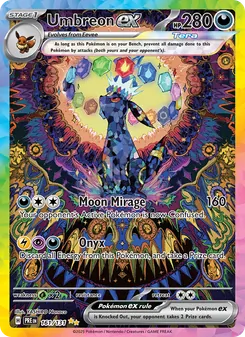
The next two Special Illustration Rares are Mew ex 232/091 from Paldean Fates at $802.58 and Mega Charizard X ex 125/094 from Phantasmal Flames at $520.02, the most valuable card in the seven Mega Evolution sets. For single sets in detail, see the chase-card guides for Delta Reign, Perfect Order, Chaos Rising and Pitch Black; for the anniversary set with its Pikachu Rares and Futuristic Rares, see the 30th Celebration Pokémon cards guide.
How rarity prices moved in November 2026
Rarity medians are not fixed. We compared the same cards on November 9 (or 10) and November 24, 2026, using every card with a price on both days. "Went down" is the share of cards that lost more than 2 %.
| Rarity | Nov 9 | Nov 24 | Went down |
|---|---|---|---|
| Common | $0.16 | $0.17 | 34 % |
| Double Rare | $0.70 | $0.67 | 53 % |
| Ultra Rare | $2.15 | $1.95 | 61 % |
| Illustration Rare | $9.96 | $9.32 | 68 % |
| Special Illustration Rare | $28.66 | $27.25 | 74 % |
| Mega Hyper Rare | $151.93 | $144.74 | 8 of 9 |
The gold-star cards cooled off: 169 of 228 Special Illustration Rares lost more than 2 % in two weeks (median change -5.5 %), and so did 338 of 500 Illustration Rares (-4.8 %). Commons and Uncommons moved up by a cent. Part of the drop is the newest set settling after release: Delta Reign came out on November 6. If you plan to sell a gold-star card, check its price on the day, not a number from last month.
More stars does not always mean a higher price
The star count ranks how hard a card is to pull, and the market mostly follows the artwork and the Pokémon. The clearest case is Hyper Rare: three gold stars, yet in Scarlet & Violet its median ($7.60) is below Illustration Rare with a single gold star ($11.42). Collectors pay more for the art cards.
It holds set by set (median prices of Illustration Rare ★, Special Illustration Rare ★★ and Hyper Rare ★★★, all gold stars):
| Set | ★ | ★★ | ★★★ |
|---|---|---|---|
| 151 | $36.16 | $63.57 | $3.67 |
| Surging Sparks | $5.67 | $20.13 | $9.69 |
| Prismatic Evolutions | none | $37.42 | $7.40 |
| Destined Rivals | $4.76 | $39.73 | $13.31 |
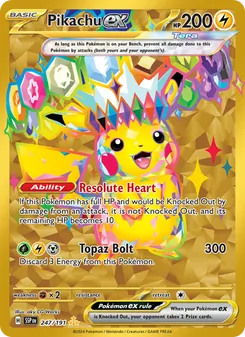
The same goes for single cards. Pikachu ex 247/191, the most valuable Hyper Rare of the era, is $64.05, while the one-star Magikarp Illustration Rare from Paldea Evolved is $284.08. So use the symbol to sort your cards, then check the price of each gold-star card one by one.
Special rarities you will see in card lists
Some cards carry a rarity name that is not in the main chart. You will see these names on our set pages and in most price lists.
- ACE SPEC Rare: powerful Trainer cards with an "ACE SPEC" banner, one per deck in play. Median $0.46 in Scarlet & Violet; Hero's Cape from Temporal Forces is the top one at $25.33.
- Shiny Rare and Shiny Ultra Rare: shiny versions of Pokémon from Paldean Fates (120 Shiny Rares and 12 Shiny Ultra Rares). Shiny Rares have a median of $4.69; Pikachu 131/91 leads at $73.05.
- Black White Rare: the four top cards of Black Bolt and White Flare. They are the most valuable rarity of the era, with a median of $538.27; Victini 171/86 is $591.99.
- Mega Attack Rare: a tier in Ascended Heroes (7 cards, median $4.22).
- Mega Hyper Rare: the top Mega ex cards of each Mega Evolution set, one or two per set (9 cards, median $144.74).
- Promo: cards from boxes, events and collections are marked with a black star and the word PROMO instead of a set rarity.
Cards numbered above the set total (like 161/131) are secret rares. In Scarlet & Violet and Mega Evolution sets that is every card from Ultra Rare up (all silver and gold stars), so a number higher than the set size is a good first sign that you hold one of the valuable ones.
Rarity symbols on older Pokémon cards
The first sets used only three symbols: circle, diamond and star. A holo rare and a regular rare both have the star, so on these cards the holofoil on the artwork is what sets the price. Here are the median Unlimited market prices from the first three sets (● Common, ◆ Uncommon, ★ Rare without holo, and holo rare):
The most valuable holo rare is Charizard 4/102 from Base Set at $1,001.05. Even commons from these sets are worth more than modern ones: Pikachu 58/102 from Base Set is a common at $7.84. A 1st Edition stamp on the left of the art raises the price again, by a median 3.2 times on Jungle and Fossil holos: see how to tell if a Pokémon card is First Edition and the old Pokémon card value guide.
Sword & Shield (2020 to 2023) used black stars for every rare and marked the special cards by name and number instead: V and VMAX cards, full arts, rainbow and gold secret rares above the set total. Use the card number and the set list to place them.
How to tell if a Pokémon card is rare
- Find the symbol next to the card number. Circle and diamond: common or uncommon. Star: rare or better.
- Read the color and count. Black stars are pack rares. Silver and gold stars are the chase cards of modern sets.
- Compare the number with the set total. A number above the total (215/203) is a secret rare.
- Check the finish. On older cards, holofoil art means a holo rare. On any card, foil outside the art means a reverse holo, worth a little more than the normal print.
- Check the price of the exact printing. Rarity sorts your cards, but only the price tells you what they are worth. A free card scanner like FoilScan reads the set and number for you and shows the market price of that exact card.
Rarity is one signal among several; the guide to what Pokémon cards are worth money adds the era and the Pokémon, and how much are my Pokémon cards worth walks through pricing a whole pile. Once you have found your best cards, add them to your binder to follow their value. Before you sell or buy a high-value card, run the checks for fake Pokémon cards, because counterfeiters copy exactly these rarities.
Common questions
What is the rarest Pokémon card rarity symbol?
In modern sets the highest rarity is three gold stars, Hyper Rare (called Mega Hyper Rare in Mega Evolution sets). In Scarlet & Violet sets that is not the most valuable tier though: Special Illustration Rares (two gold stars) have a higher median price, $23.61 against $7.60.
What does a gold star mean on a Pokémon card?
A gold star marks a secret rare. One gold star is an Illustration Rare, two are a Special Illustration Rare, and three are a Hyper Rare. All are numbered above the set total, and every Scarlet & Violet Illustration Rare is worth more than $1.
What do two black stars mean on a Pokémon card?
Two black stars mean Double Rare: a regular ex card with the same frame as the rest of the set. Their median price is $0.71 in Scarlet & Violet sets and $0.61 in Mega Evolution sets, so most are not valuable on their own.
Is a star on a Pokémon card always rare?
A star means the card is at least Rare, but a single black star in a modern set is the most common kind of rare, with a median price of $0.20. On cards from 1999 and 2000, a star with holofoil art is a holo rare, which is where most of the value of those sets is.
Do Japanese Pokémon cards use the same rarity symbols?
No. Japanese cards print letter codes instead of shapes, such as C, U, R, RR, AR, SR, SAR and UR. The tiers line up with the English ones (AR is an Illustration Rare, SAR a Special Illustration Rare), but check the set list for the exact printing.