

The difference between a holo and a reverse holo Pokémon card is where the foil is. On a holo, only the artwork box shines; on a reverse holo, the border, background and text box shine and the artwork stays flat.
The finish also changes the price, and the same card in the two finishes is priced separately. On a modern common, the reverse holo is worth about 1.7 times the normal copy, which still means cents. On cards from 2002 to 2010, the reverse holo can be worth 5 to 100 times the normal copy. Below are the checks, a table by era, and the cards where the gap is biggest. All prices are TCGplayer near-mint market prices in USD from FoilScan's daily price record, as of November 7 to 14, 2026 (most from November 12 and 13). They are reference prices, not appraisals. If you have one card in front of you, scan the card and pick the finish you see on the confirm screen: the price changes with it.
How to tell a holo from a reverse holo
Tilt the card under a lamp or a window and watch which part catches the light.
| Normal (non-holo) | Holo | Reverse holo | |
|---|---|---|---|
| Artwork | Flat | Shiny | Flat |
| Border and text box | Flat | Flat | Shiny |
| Which cards | Commons, uncommons, older rares | Rares (all rares since 2023) | Any card up to rare, one or more per pack |
Three details help when the light is bad:
- Run a finger of light across the art. A holo picture flashes rainbow or sparkles when you move it. A reverse holo picture looks exactly like a normal card's picture.
- Look at the text box. On a reverse holo, the attack text and the weakness line sit on a foil background. On a holo, the text box is plain card stock.
- Check the rarity symbol. A circle (common) or diamond (uncommon) card with a shiny picture is unusual; a shiny border on a circle or diamond card is a reverse holo. The rarity symbols chart explains every symbol.
A few things are not "holo vs reverse holo" at all. Ultra rare cards such as ex, V and VMAX cards, full arts, Illustration Rares and gold cards are foil or textured across the whole card. Since Scarlet & Violet they come only in that one finish, so there is no reverse version to compare. Our catalog confirms it: of the 1,729 Scarlet & Violet and Mega Evolution cards we price above Rare (Double Rare, Ultra Rare, Illustration Rare and up), none has a reverse holo price.
Which cards come in which finish
Reverse holos arrived in English with Legendary Collection in 2002, whose reverse holos have a fireworks pattern. Since then almost every set prints a reverse holo version of its commons, uncommons and rares, and modern booster packs carry at least one per pack.
How it works in today's sets, from our catalog of Scarlet & Violet and Mega Evolution cards:
- Commons and uncommons: a normal copy and a reverse holo copy.
- Rares: a holo copy (the version you pull in the rare slot) and a reverse holo copy. Non-holo rares stopped with Scarlet & Violet in 2023.
- Double Rare and above: one foil version only.
Some recent sets add special reverse holo patterns on top of the standard one. Prismatic Evolutions, Black Bolt and White Flare have reverse holos with a repeating Poké Ball or Master Ball pattern, and Ascended Heroes adds Energy and other ball patterns. Those are separate versions with their own prices; the tables below use the standard reverse holo.
Which is worth more: prices by era
These two tables compare the same cards in both finishes. Prices are medians.
Commons and uncommons: the normal copy against the reverse holo copy (× is the median of the per-card ratios, 9,064 pairs).
| Era | Normal | Reverse holo | × |
|---|---|---|---|
| Legendary Collection (2002) | $1.61 | $152.34 | 98× |
| e-Card (2002–03) | $11.83 | $57.99 | 4.8× |
| EX (2003–07) | $1.33 | $25.48 | 16.5× |
| Diamond & Pearl (2007–08) | $0.61 | $4.92 | 6.5× |
| Platinum (2009) | $0.60 | $5.49 | 6.5× |
| HeartGold SoulSilver (2010) | $0.75 | $8.76 | 8.8× |
| Call of Legends (2011) | $0.65 | $7.56 | 9.1× |
| Black & White (2011–13) | $0.38 | $1.76 | 4.0× |
| XY (2013–16) | $0.27 | $0.71 | 2.8× |
| Sun & Moon (2017–19) | $0.26 | $0.50 | 2.3× |
| Sword & Shield (2019–23) | $0.14 | $0.29 | 2.1× |
| Scarlet & Violet (2023–25) | $0.15 | $0.24 | 1.7× |
| Mega Evolution (2025–26) | $0.13 | $0.23 | 1.8× |
Holo rares that also exist as a reverse holo, with the share of cards where the reverse holo is the more expensive copy (1,565 pairs).
| Era | Holo | Reverse | Rev. higher |
|---|---|---|---|
| Legendary Collection (2002) | $71.97 | $399.99 | 100% |
| e-Card (2002–03) | $155.37 | $100.10 | 19% |
| EX (2003–07) | $41.91 | $53.63 | 71% |
| Diamond & Pearl (2007–08) | $26.39 | $21.80 | 26% |
| Platinum (2009) | $19.20 | $16.81 | 38% |
| HeartGold SoulSilver (2010) | $15.27 | $15.43 | 51% |
| Call of Legends (2011) | $46.96 | $40.72 | 32% |
| Black & White (2011–13) | $4.36 | $6.44 | 83% |
| XY (2013–16) | $2.04 | $2.46 | 80% |
| Sun & Moon (2017–19) | $1.28 | $1.48 | 75% |
| Sword & Shield (2019–23) | $0.33 | $0.44 | 90% |
| Scarlet & Violet (2023–25) | $0.20 | $0.29 | 97% |
| Mega Evolution (2025–26) | $0.17 | $0.26 | 98% |
What the numbers say:
- For commons and uncommons, the reverse holo always wins. In every era the reverse holo copy is worth more than the normal copy, for 97% to 100% of cards. The gap is small on modern cards and large on anything from before 2011.
- For holo rares, it depends on the era. On modern cards the reverse holo is usually a few cents more. On e-Card, Diamond & Pearl, Platinum and Call of Legends cards, the holo is usually the more valuable copy. Legendary Collection is the exception: its fireworks reverse holos beat the holos on all 17 pairs we price.
- Modern bulk stays bulk. Of 2,358 Scarlet & Violet and Mega Evolution common and uncommon reverse holos, only 34 are worth $1 or more. A stack of them is worth cents per card.
Where the finish changes the price most
Vintage reverse holos (2002 to 2005)
| Card | Holo or normal | Reverse holo |
|---|---|---|
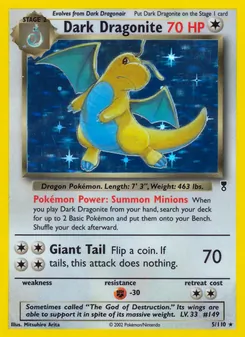
| Dark Dragonite, Legendary Collection 5 | $239.67 (holo) | $1,300.00 |
| Dark Blastoise, Legendary Collection 4 | $274.99 (holo) | $975.00 |
| Venusaur, Legendary Collection 18 | $159.99 (holo) | $799.99 |
| Articuno, Legendary Collection 2 | $71.97 (holo) | $749.99 |
| Pikachu, Legendary Collection 86 | $6.69 (normal) | $1,574.99 |
| Charmander, Legendary Collection 70 | $2.06 (normal) | $662.25 |
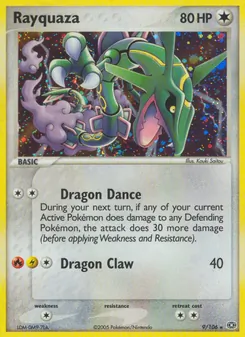
| Rayquaza, Emerald 9 | $431.32 (holo) | $1,078.45 |
A Legendary Collection Pikachu is a common worth $6.69, and the reverse holo copy of the same card is $1,574.99. If you own Legendary Collection cards, the finish is the first thing to check. Prices this high rest on few sales, so check several recent sales before you buy or sell.
Older holo rares where the holo is worth more
| Card | Holo | Reverse holo |
|---|---|---|
| Rayquaza, Legends Awakened 14 | $447.50 | $111.65 |
| Lugia, Secret Wonders 14 | $436.20 | $232.26 |
| Glaceon, Majestic Dawn 5 | $294.79 | $79.34 |
| Mew, Expedition Base Set 19 | $525.00 | $267.53 |
| Alakazam, Expedition Base Set 1 | $271.50 | $115.49 |
Single cards still go against the trend: Secret Wonders Charizard is $208.66 as a holo and $441.24 as a reverse holo. That is why a price for "the card" without the finish can be off by half or double.
Modern cards where the reverse holo stands out
| Card | Holo or normal | Reverse holo |
|---|---|---|
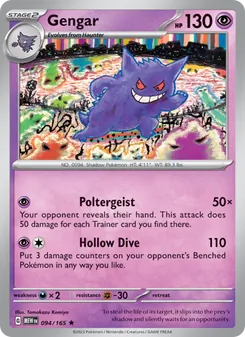
| Gengar, 151 094 | $2.81 (holo) | $10.25 |
| Snorlax, 151 143 | $0.28 (normal) | $3.83 |
| Mewtwo, 151 150 | $1.87 (holo) | $3.06 |
| Dragonite, 151 149 | $1.50 (holo) | $2.95 |
| Umbreon, Obsidian Flames 130 | $0.38 (normal) | $2.57 |
| Jolteon, Prismatic Evolutions 029 | $0.34 (holo) | $0.32 |
Popular Pokémon from 151 and Eeveelutions carry most of the modern reverse holo value. The Prismatic Evolutions Jolteon shows the usual modern case: holo and reverse holo within a few cents of each other.
How to price your card with the right finish
- Find the set symbol and the card number, for example 094/165.
- Tilt the card and decide: flat (normal), shiny picture (holo) or shiny border (reverse holo).
- Look up the price for that finish, not the card in general.
The free card scanner does steps 1 and 3. Point your phone at the card, confirm the card it finds, and choose normal, holo or reverse holo on the confirm screen; the price shown is for that finish. Add the card to a binder and the collection total follows the finish you picked. For older cards, the old Pokémon card value guide and how to tell if a Pokémon card is First Edition cover the other things that move a vintage price.
Common questions
Which is rarer, holo or reverse holo?
It depends on the card. A modern rare comes as a holo in the rare slot and as a reverse holo in the reverse slot, and the prices are close: across Scarlet & Violet and Mega Evolution the reverse holo is the higher-priced copy for 97% of rares, by a median of about 9 cents. For commons and uncommons, the reverse holo is always the scarcer copy.
Are reverse holo Pokémon cards worth anything?
Most modern ones are worth cents: the median Scarlet & Violet common or uncommon reverse holo is $0.24. Older reverse holos are another story. The median Legendary Collection common or uncommon reverse holo is $152.34, and EX era ones are $25.48 (November 2026).
Are holo Pokémon cards worth anything?
A modern holo rare usually is not: since 2019 the median holo rare is $0.17 to $0.33. Holo rares from 2002 to 2011 are worth much more, a median of $15 to $155 depending on the era, and the best reach several hundred dollars.
What is a reverse holo Pokémon card?
A reverse holo is a version of a normal card where the foil covers everything except the artwork: the border, background and text box shine, the picture stays flat. Most sets since 2002 print one for each common, uncommon and rare.
Is a full art card a holo or a reverse holo?
Neither. Full arts, ex cards, Illustration Rares and gold cards have their own foil or textured finish across the whole card and come in one version only. Their price depends on the card itself, not on a holo choice.