

To find out how much your Pokémon cards are worth, identify each card exactly (set, card number, finish and edition), then look up its recent market price for that exact printing. The name alone tells you almost nothing: ten English cards simply called Charizard, shown below, range from $3.67 to $1,001.05.
Most cards in a typical pile are worth cents, so the real job is finding the few that are not. The numbers in this guide come from FoilScan's daily price record: TCGplayer near-mint market prices in USD for 33,243 English card printings, as of November 15 to 18, 2026. They are reference prices for ungraded cards, not appraisals. If you have one card in hand right now, scan the card with your phone and you will see the matching printing and its price in a few seconds.
Why the name is not enough: one Pokémon, ten prices
Search "Charizard card value" and you get a wall of numbers that do not agree. That is because Charizard has been printed dozens of times. These are ten of the more than 20 English cards named just "Charizard" (no ex, V or GX), each with its market price (tap a number to open the card):
| Set | No. | Finish | Price |
|---|---|---|---|
| Base Set (1999) | 4/102 | Holo | $1,001.05 |
| Legendary Collection (2002) | 3/110 | Holo | $899.99 |
| Stormfront (2008) | 103/100 | Holo | $527.91 |
| Base Set 2 (2000) | 4/130 | Holo | $513.67 |
| Expedition (2002) | 39/165 | Normal | $207.65 |
| Arceus (2009) | 1/99 | Holo | $113.45 |
| Evolutions (2016) | 11/108 | Holo | $93.49 |
| Team Up (2019) | 14/181 | Normal | $17.33 |
| Pokémon GO (2022) | 010/078 | Holo | $4.38 |
| Vivid Voltage (2020) | 25/185 | Normal | $3.67 |
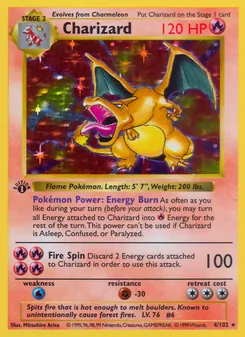
Look at the first and the seventh rows. The 2016 Evolutions card reuses the 1999 Base Set artwork, yet it is worth about a tenth as much. The two cards look almost the same in a photo. They differ in the number (11/108 against 4/102), the set symbol and the copyright year at the bottom. That is why every price check starts with the small print, not the picture. (A few rarer printings go even higher: Charizard 100/97, a secret rare from the 2003 Dragon set, is $1,499.99.)
Step 1: find the set and the card number
Every card since 1999 carries two things that pin it down:
- The card number, bottom left or bottom right, such as 4/102 or 199/165. The first part is the card's place in the set, the second is the size of the main set. A first number higher than the second (like 103/100) means a secret rare, and those are usually the expensive ones.
- The set symbol, a small icon near the number or under the artwork. Since 2023, cards also print a short set code next to the number. Base Set cards from 1999 have no symbol at all, which is itself the clue.
Name plus number plus set symbol identifies one card out of more than 20,000 English cards. If you are unsure what the symbols mean, our guide to Pokémon card rarity symbols shows each one. Or skip the squinting: the free card scanner reads the name and number from a photo, shows you the closest matches, and you confirm the right one.
Step 2: check the finish (it often doubles the price)
The same card number can exist in two or three finishes, and each one has its own price:
- Normal: no shine on the card.
- Holo: the artwork window shines.
- Reverse holo: the artwork is flat but the rest of the card shines.
Of 10,966 English cards we price in both a normal and a reverse holo version, the reverse holo is worth more in 98.8% of cases, and at least twice as much in 66%. The median reverse holo is worth 2.46 times the normal copy. The gap grows with age and peaks in the EX era (pairs = cards we price in both finishes):
| Era | Pairs | Reverse vs normal |
|---|---|---|
| Scarlet & Violet (2023–2025) | 1,865 | 1.71× |
| Sword & Shield (2020–2022) | 1,771 | 1.96× |
| Sun & Moon (2017–2019) | 1,588 | 2.16× |
| XY (2014–2016) | 1,151 | 2.63× |
| Black & White (2011–2013) | 979 | 3.66× |
| HeartGold SoulSilver (2010–2011) | 311 | 7.09× |
| Platinum (2009–2010) | 400 | 5.42× |
| Diamond & Pearl (2007–2008) | 656 | 5.18× |
| EX (2003–2007) | 1,189 | 14.50× |
| e-Card (2002–2003) | 405 | 3.75× |
So a reverse holo from 2004 is a very different card from the normal copy in the same binder page. Two examples from the table above: Charizard 39/165 from Expedition is $207.65 as a normal card and $540.00 as a reverse holo; Charizard 14/181 from Team Up is $17.33 normal and $45.89 reverse holo. Not sure which finish you have? See holo vs reverse holo for how to tell them apart under a lamp.
Step 3: look for a 1st Edition stamp (older cards only)
Cards from 1999 to 2002 (Base Set through the Neo sets) were printed first with a small black "Edition 1" circle on the left under the artwork, then again without it. The stamp matters a lot. Of 817 cards we price in both 1st Edition and Unlimited versions, the 1st Edition copy is worth more in 98.7% of cases and at least twice as much in 78%; the median is 2.84 times the Unlimited price.
No stamp means Unlimited, which is the far more common printing. Our guide on how to tell if a Pokémon card is first edition covers the stamp, the Shadowless border and the fakes that copy them.
Step 4: read the market price, not the asking prices
Once you know the exact printing, you will see several prices for it. Only one of them answers "what is it worth":
- Market price is based on what copies have recently sold for. This is the number to use. Every price in this guide is a market price.
- Lowest listing is the cheapest copy currently for sale. It is often a worn copy or a one-off seller. Across our 33,243 printings, the lowest listing is under the market price 95% of the time, and the median lowest listing is 40% of the market price.
- Highest listing is whatever the most hopeful seller typed in. In our data the highest listing is at least ten times the market price for 77% of printings, and the median is 26 times. A $10,000 listing for a $93 card is normal and means nothing.
The same goes for auction results you find in search: a record sale of a graded copy says little about the raw card in your hand. If you plan to sell, our article on what Pokémon cards are worth money explains which cards carry real demand.
Step 5: be honest about condition
Market prices assume a near-mint card: sharp corners, clean edges, no creases, scratches or whitening on the back. Cards that were played, kept in a shoebox or carried in a pocket sell for less, and a crease or water damage cuts the price sharply. The exact discount depends on the card and the buyer, so treat the near-mint price as the ceiling for your copy, not the starting point.
Professional grading is a separate question. A card worth a few dollars raw is almost never worth sending for a grade, because the fee alone costs more than the card.
How to sort a pile of cards fast
If you have hundreds of cards, do not price them one by one. Sort first, then price only the cards that can matter. On modern cards (Scarlet & Violet and Mega Evolution, 2023 to 2026), the rarity symbol tells you most of the story. This table covers 7,138 printings; it shows the median price and the share worth at least $1 and at least $10:
| Rarity | Median | $1+ | $10+ |
|---|---|---|---|
| Common ● | $0.18 | 1% | 0% |
| Uncommon ◆ | $0.20 | 1% | 0% |
| Rare ★ | $0.23 | 3% | 0% |
| Double Rare ★★ | $0.66 | 23% | 0% |
| Ultra Rare ★★ silver | $1.98 | 84% | 5% |
| Illustration Rare ★ gold | $8.97 | 99% | 46% |
| Hyper Rare ★★★ gold | $7.51 | 100% | 33% |
| Special Illustration Rare ★★ gold | $27.61 | 100% | 90% |
A simple order that works:
- Pull every card with a gold star, plus anything numbered above the set size. Price each one. Our Special Illustration Rare guide lists the most valuable ones.
- Pull every card from before 2011, every holo and reverse holo from before 2011, and anything with a 1st Edition stamp. Most of these are worth $1 or more; see old Pokémon card value.
- Pull the popular Pokémon (Charizard, Pikachu, Umbreon, Gengar, Mew, Rayquaza) from any era.
- Everything else is very likely bulk: modern commons, uncommons and plain rares worth $0.10 to $0.30 each.
For the cards you pulled, a phone scan is faster than typing names into a search box. Save each match to a binder and you get a running total of the collection's value that updates with the daily prices.
Where these prices come from
FoilScan records the TCGplayer near-mint market price for every English card printing it can match, every day, and keeps the history. The figures above use the latest price of each printing, last updated between November 15 and 18, 2026 (a small number of printings were last updated earlier). Prices move: a new set, a tournament result or a reprint can shift a card within days, so check again before you buy or sell. Card pages, such as Base Set Charizard, show the current price and its recent trend.
Common questions
How much are my Pokémon cards worth?
It depends on the exact printing. Find the card number, the set symbol, the finish (normal, holo or reverse holo) and any 1st Edition stamp, then look up the market price for that exact card. Most modern commons and uncommons are worth under $0.25; older holos, gold-star rarities and popular Pokémon are where the value is.
How do I check the value of a Pokémon card for free?
Use a free price lookup that matches the exact printing. With FoilScan you take a photo, confirm the matched card, and see its near-mint market price. You can also search the card name and number on a price guide; just make sure the set and finish match your card.
Why are there so many different prices for the same card?
Because a single name covers many printings, and each printing has normal, holo, reverse holo or 1st Edition versions with their own prices. Listings add more noise: in our data the highest asking price is at least ten times the market price for 77% of printings.
Are my old Pokémon cards worth anything?
Often, yes. Cards from 1999 to 2010 are worth $1 or more in most cases, and holos from those years are often worth much more. Our old Pokémon card value guide has prices for the most common old sets.
Can a scanner tell me what condition my card is in?
No. A scanner identifies the card and shows reference prices for near-mint copies. Judging corners, edges and surface, or predicting a grade, is up to you or a grading company. FoilScan does not estimate condition or grades.